
Digital Accreditation
- Digital Certificates Accrediation
- Annual Benefits
- Treasury Banking CA
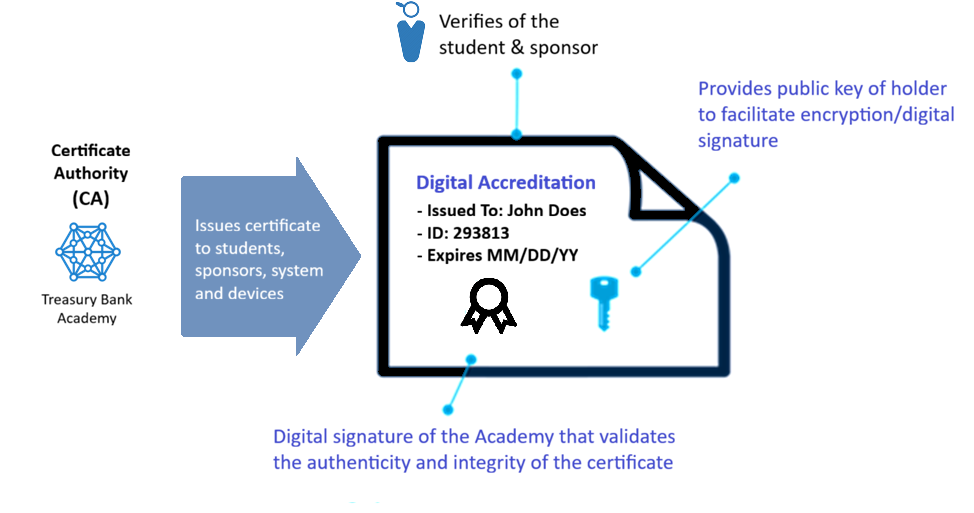
What is a Digital Accreditation?
This is the process of formally verifying and recognizing online Treasury Banking MADIBA education and digital learning programs to ensure quality, integrity, and standards. It also refers to secure, verifiable digital certificates and badges used to instantly prove academic or professional skills for monetary value.
A MADIBA digital certificate is a small computer file. It is used to establish a relation between both the students and their public keys. A digital certificate contains two things, i.e. the name of the student and their public key. So that we can identify that the particular key belongs to the particular user.
The information secured by a digital certificate contains is as follows:
- Member Name
- Other data like email, phone, etc
- Issuer name: Sponsor or Program
- Public key
- Serial number
- Valid from date
- Valid to date
- CA – TBO
Treasury Bank Organization Certificate of Authority (TBOCA)
The TBOCA confirm and certify the MADIBA completion as an online reference data and Certificate of Authority. A Certificate of Authority is a formal legal document (e.g., a “Certificate of Good Standing” or “International Qualification”) issued by the TBO, allowing graduates to operate under a certified authority for treasury banking.
Purpose:
- Authenticate academic records
- Verify issued credentials
- Digitally sign certifications
- Validate curriculum completion
- Protect record integrity
Step 1 – Key Generation
In this step, a key is generated. A key can be generated using two approaches.
Approach 1:
The members creates a private and public key pair using the software. Students must keep their private key secret. A student sends the public key with additional information to the Corporate Registered Administrator CRA as an intermediate between the TBO and the students.
Approach 2:
An CRA generates a key pair for a user. The possibility of this approach is needed when the user is unaware of the technical and software knowledge. The disadvantage of this approach is CRA can find out the private key of the member.
Step 2 – Registration
This step is required only if the member generates the pair of keys. If a TBO’s CRA generates the pair of a key for the students, then key registration is done in the 1st step only. A member sends his/her public key and some other information to the CRA. This software provides a wizard where members enter details and submit. Then the data travel through the network and reach the CRA. After that students request for the certificate will be registered, and the format for the certificate request will be standardized. This process is called a CSR (Certificate Signing request).
Step 3 – Certificate Signing Request CSR
A Certificate Signing Request (CSR) is an encoded text file sent to Treasury Bank Academy to apply for a digital SSL/TLS certificate. It contains student’s identifying information (like personal name, domain name and company details) and your public key, which the TBO verifies and uses to issue your certificate
Step 4 – Verification
After the registration process is complete, CRA identifies the member credentials.
Step 5 – Certificate Creation
After all the above-mentioned processes were completed, CRA passed all the details to the Treasury Bank Portal. The Portal electroncally cross-verifies all the details and generates a digital certificate for the member. The Academy sends the certificate to the students and keeps one copy of that to keep the records. The Copy of the certificate is stored in the certificate directory.
Digital Accreditation Lifecycle
Enrollment
↓
Course Completion
↓
Instructor Approval
↓
Treasury Bank Certification Board Review
↓
Digital Accreditation Issued
↓
AWS Aurora Record Created
↓
Unique Credential ID
↓
QR Verification
↓
Corporate Sponsor Verification
↓
Continuing Education Updates